The best one is the one you still open in month four.
The best AI calorie tracker is not the one that
guesses the photo best.
Every AI calorie app is roughly equivalent at the photo step — within ~20% on common meals. The real difference is what happens 30 seconds after the estimate. This is the lens to use: 'when I'm tired and the day is going sideways, does this app actually help me?' That's the bar most trackers fail at month four.
The 'best calorie tracker' is the one you still open in month four.
Every calorie app has a 90-day cliff. People sign up, log religiously for three to six weeks, and then quietly stop opening it. The calorie tracking industry is built on that pattern.
What separates the apps women actually keep using long-term isn't photo accuracy. It's whether the app does something useful after the photo — like help with a restaurant, a fridge full of nothing, or a 3pm crash.
That's the lens to use when picking a tracker. Not 'how good is the AI guess.' Instead: 'when I'm tired and the day is going sideways, does this app actually help me?'
What changes
-
Photo accuracy varies less than the marketing implies — most apps land within ~20% on common meals.
-
The real differentiator is what happens in the 30 seconds after the estimate.
-
For women, hormonal context (cycle, sleep, cortisol) matters more than calorie precision.
Pick by what breaks first.
Photo accuracy is roughly equivalent across the top apps. The real difference is in the boring rows below.
Photo estimate
Avela
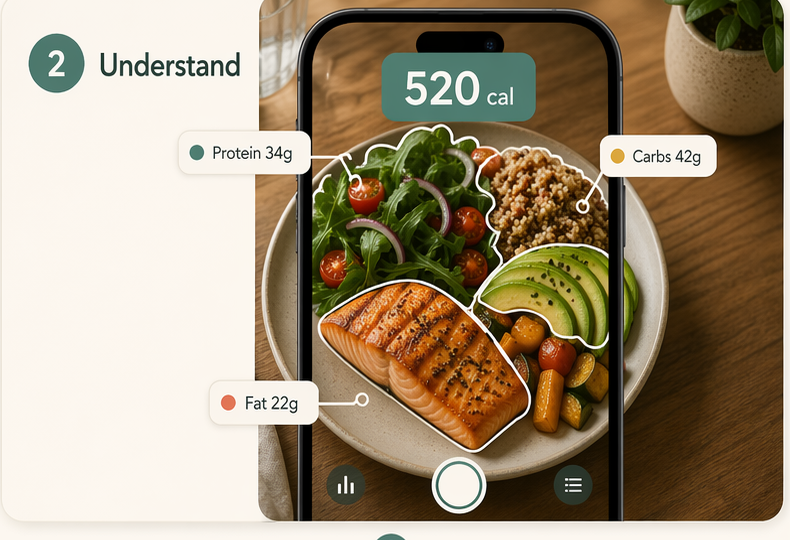
Photo-first range plus a protein cue and one next-step recommendation.
Typical photo tracker
Single calorie number that reads more exact than the underlying physics allows.
Takeaway
Ranges are honest. Numbers are confidence theater.
After the estimate
Avela
Connects to fridge, menu, weekly plan, and a coach who answers in 90 words.
Typical photo tracker
Logs the meal in a diary. The user is on their own from there.
Takeaway
The next decision is where behavior actually changes.
Restaurant support
Avela
Menu scanner picks an order, a backup, and a swap. Built into the product, not a workaround.
Typical photo tracker
Restaurant use depends on manual database search or generic advice.
Takeaway
Eating out is where most plans break. It needs its own workflow.
Bad-day handling
Avela
No streaks. The bad day resets at midnight. Sunday recalibration absorbs the week.
Typical photo tracker
Streak break, then ghost-quit by month two.
Takeaway
The system that survives Tuesday is the one you still use in month four.
Hormonal / 35+ context
Avela
Adjusts to cycle phase, sleep, and the cortisol-driven 3pm crash. Built for women of all ages.
Typical photo tracker
Same plan in week one and week six. No accommodation for cycle, perimenopause, or sleep debt.
Takeaway
A static plan stops working when the body stops being static.
Manual fallback
Avela
Photo, barcode, and text — whichever is easiest in the moment counts.
Typical photo tracker
Strongest in one input mode. The other modes feel like an afterthought.
Takeaway
Flexible input is the difference between sticking and quitting.
Behind the result.
Most 'best AI calorie tracker' lists rank apps by photo accuracy. That's the wrong metric.
Photo accuracy varies less than the marketing suggests. The thing that actually predicts whether you're still using an app in month four is what the app does after the photo — restaurants, fridge, coaching, and how it handles a missed day.
This is an honest comparison of what to look for, written for women who have already tried (and quit) MyFitnessPal, Noom, Cal AI, and at least one wearable.
Photo accuracy is roughly equivalent across the top apps. Stop using it as the deciding factor.
Restaurant, barcode, and text fallback keep tracking alive when the photo is ambiguous.
Plans should adjust to the week you actually had, not punish you for a missed Wednesday.
The reviews that actually matter.
“Tried Cal AI, MyFitnessPal, Lose It, Noom. Avela is the first one that's lasted past 60 days. The fridge and menu features are why.”
“I'm 49 and the hormonal piece is the part nobody else talks about. Avela's the only one that adjusts when I'm in the second half of my cycle.”
What this is. What it isn’t.
This comparison is based on product workflow, not vendor benchmarks or sponsored testing.
Photo accuracy varies by cuisine, lighting, portion visibility, and whether the meal has barcoded components.
Choose based on the part of food tracking that breaks for you — not on which app demos best.
Updated 2026-05-09. Planning estimates only. Not medical advice.
Real questions.
Honest answers.
If you’ve tried three other apps, this is probably what you actually want to know.
No, and the data backs this up. The 5–10% accuracy gap between top apps is dwarfed by the ~70% who quit by week six. Pick for what makes you actually keep using it, not for marginal AI accuracy improvements that you'll never benefit from in month four.
Keep the next decision connected.
Each tool is built for a different moment in the day. Together, they replace four apps.
Photo calorie counter
Estimate any meal from a photo, in three seconds.
Restaurant menu scanner
Three picks, one swap, no menu spiral.
Best AI calorie tracker
What to actually look for after the photo.
MyFitnessPal alternative
For women done with manual database logging.
Cal AI alternative
When the photo is the easy part.
Last step
The first 10 pounds.
Without counting a single calorie.
Built for women whose bodies stopped responding to the old playbook.
$1 trial. 7 days, full access. Cancel in one tap.