
Less logging. More decisions you can actually use.
Calorie tracking without
manual logging.
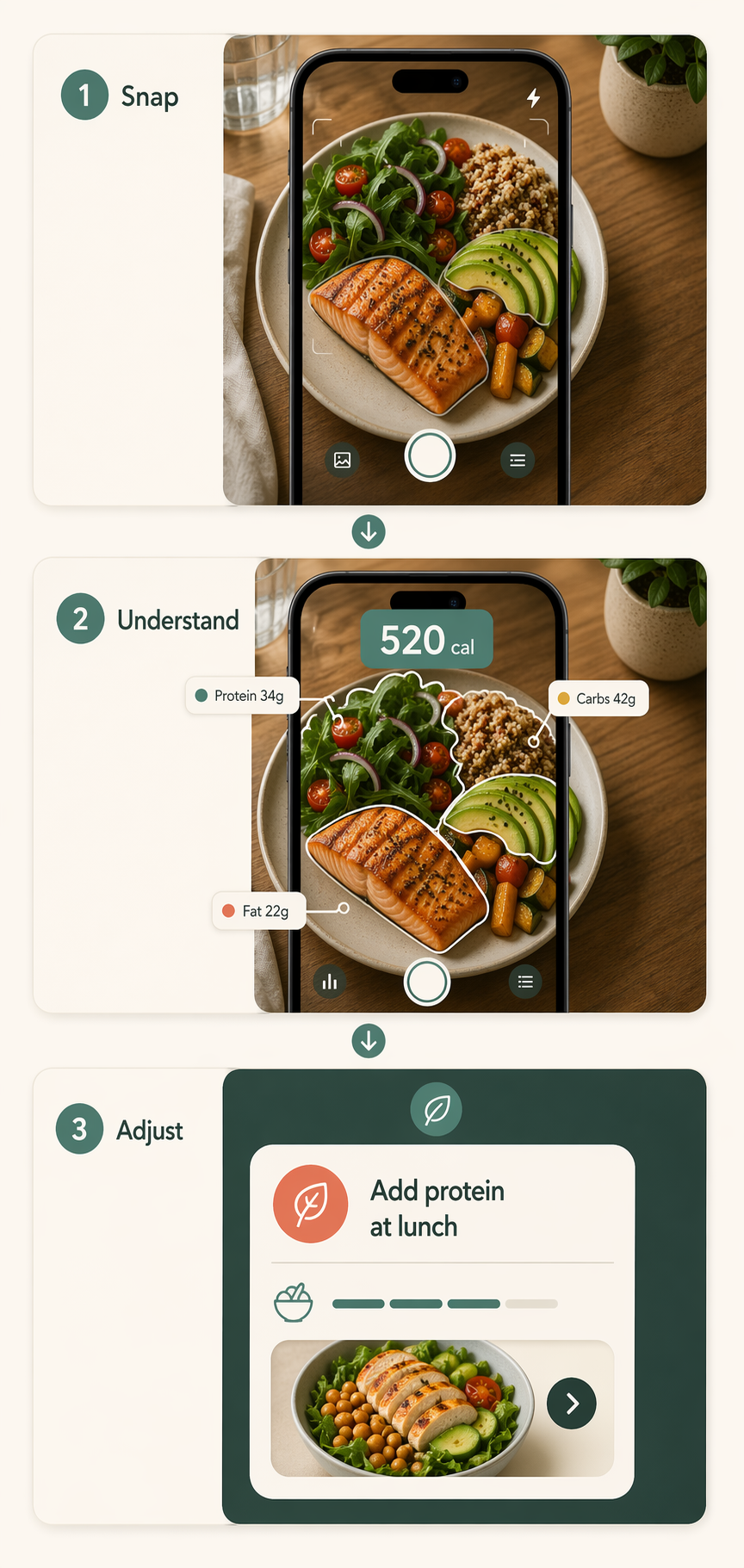
Manual logging fails because it asks you to become a food database operator. Avela takes the opposite path: photo in, menu in, fridge in, short note in — then one useful calorie range, one protein cue, and one next move.
Why manual logging breaks even when the math is right.
Manual food logging has a hidden cost: attention. It asks for precision at the exact moments people have the least patience — lunch between meetings, dinner after work, takeout with family, snacks during the afternoon crash.
That is why the best workflow is not zero tracking. It is lower-friction tracking. Keep enough signal to spot patterns, but stop pretending every tablespoon of dressing can be captured perfectly in real life.
Avela treats the estimate as the beginning of coaching, not the end of tracking. The useful output is not just a calorie number. It is whether protein is low, whether the next meal should be simpler, whether a restaurant order needs one swap, or whether the week needs a reset.
What changes
-
Photos replace database search for most meals.
-
Ranges replace fake-precise numbers when portion size is uncertain.
-
Next-step coaching replaces streak pressure and restart guilt.
Behind the result.
The problem with calorie tracking is not that calories are useless. It is that the old workflow is too expensive to maintain.
Search the food. Pick the closest database entry. Guess the portion. Fix the serving size. Repeat for sauces, bites, leftovers, and restaurant meals. By week three, the app has become another job.
Calorie tracking without manual logging keeps the useful signal and drops the busywork. You still get a rough intake pattern, but the input is a photo, a menu, a fridge scan, or a short text note — not a spreadsheet.
Use photos for ordinary meals instead of searching ingredient databases.
Use menu scanning before ordering so the decision happens before the meal, not after.
Use fridge scans and weekly recalibration when life gets messy instead of restarting Monday.
The reviews that actually matter.
“I did not need another perfect tracker. I needed something I would still use after a bad day.”
“The photo estimate gets me close enough, then the app tells me what to do next. That is the part I was missing.”
What this is. What it isn’t.
No photo-based or text-based tracker can know hidden oils, exact portions, or every restaurant preparation perfectly.
The goal is to reduce logging friction while preserving enough signal for better weekly decisions.
For clinical nutrition, diabetes, pregnancy, eating disorder recovery, or medication-managed plans, follow clinician guidance first.
Updated 2026-05-09. Planning estimates only. Not medical advice.
Real questions.
Honest answers.
If you’ve tried three other apps, this is probably what you actually want to know.
Yes, if you are honest about the tradeoff. Photos, menus, and text notes are less precise than weighed logging, but much easier to keep using. For many people, a slightly rougher estimate used consistently beats a perfect database workflow abandoned after two weeks.
Keep the next decision connected.
Each tool is built for a different moment in the day. Together, they replace four apps.
Last step
The first 10 pounds.
Without counting a single calorie.
Built for women whose bodies stopped responding to the old playbook.
$1 trial. 7 days, full access. Cancel in one tap.